SLA in the World

This page showcases the reflections, observations, and experiences of our community – faculty, alumni, current students, and staff – both in the United States and abroad.

September 2025
L.J. Randolph Jr., SLA Steering Committee member
(originally posted on LinkedIn)
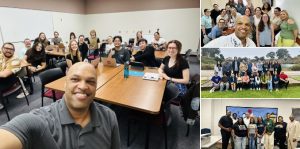
Just finished the last session of my accelerated summer course “Foundations of World Language Education.” This is one of the first courses in our 14-month M.S. in teacher education program. Over the past couple of weeks, I’ve been able to work with a bright, talented, inquisitive, and large (14 students!) group of future Chinese, French, Indonesian, Latin, and Spanish language educators. This class marks the end of a summer filled with experiences that allowed me to invest in and work with pre-service and in-service language educators. First, I spent about a month in beautiful Guanajuato, Mexico, working with a group of Spanish teachers enrolled in the Summer Language Institute—a study-abroad summer program based out of Southern Oregon University. Then, I spent a week in Santa Barbara, California, working with the Student Strand of the World Language Summer Seminar. Participants included college students and recent graduates who are considering a career path in language education. Next, I spent a few days at Howard University with the second cohort of the ABLE (ACTFL Black Language Educators) Institute. This institute was one of my initiatives as president of ACTFL in 2024. It identifies college students and recent graduates who are interested in language study and/or education and provides information and professional development on pathways to the teaching profession as well as connections with Black language education professionals. Although I didn’t really get a “break” this summer, I’m grateful that my summer was filled with opportunities to work with current and future language educators in deep, meaningful, joyful, and transformative ways. I’m exhausted, but my heart is full. 🖤
October 2025
Nelly Martin-Anatias, SLA alum (2017)
Bridging Words and Worlds
Like many moments in public spaces, my presence, due to my hijab, often becomes a site of either curiosity or scrutiny. This time, it was the former. Two women were chatting softly in Korean beside me, and when one left, the other moved closer. I smiled and greeted her in my very limited Korean. She looked delighted. What followed was a simple yet warm exchange made possible by my Duolingo lessons and hours of K-dramas. We introduced ourselves, shared where we were from, and smiled our way through the gaps in understanding. Neither of us was fluent in the other’s language, but mutual goodwill bridged what words could not. Before leaving, she shook my hand and said, “Indonesian saram (person), nice to meet you.” I replied, “Nado (me too). Pangapsumnida (Nice meeting you too).” She smiled broadly and waved as she left. As a regular at this local gym, I often exchange brief but genuine pleasantries with other regulars, mostly Korean and Chinese members, many of them older adults, reflecting the area’s demographics. Even my fragmentary Korean often elicits joy, a small gesture of respect and curiosity. Yet behind these moments lies a quiet frustration that my linguistic limitations keep me from connecting more deeply. I often leave wishing I could converse beyond greetings.
Not all encounters have been so kind. About a month ago, another Korean woman made a discriminatory remark about my Muslim swimming outfit, saying it was “too much clothing.” Her comment stung, especially because the burkini is officially recognised by Auckland Council leisure centres. That moment made me realise how language might have changed the outcome. If I had spoken Korean fluently, perhaps I could have reached her beyond the visual boundaries of my clothing. Perhaps she could have seen me as a person, not a stereotype. Language as Connection and Correction These contrasting encounters remind me, as a linguist and language educator, that language is not only a tool of communication but also of humanisation. It offers a space to connect rather than to divide, to see the person behind the difference. Each new word we learn in another’s language is a gesture of empathy, a step toward mutual recognition. In multilingual spaces like Auckland, where migration and diversity converge daily, language becomes both a bridge and a boundary. Even a few shared words can soften difference, while the absence of a shared language may magnify misunderstanding. To me, these moments reaffirm a deeply human truth: we do not live in an insular world. To learn another language is to gain new tools for belonging, to challenge our assumptions, and to open pathways toward solidarity. Every sincere “annyeonghaseyo,” “ni hao,” or “apa kabar” carries more than phonetic meaning; it carries the possibility of connection.
Tāmaki Makaurau, 5 October 2025